
Top BJJ Joint Health Habits for Hard Training
Your elbow does not care that you have a tournament in six weeks. Your knee does not care that your training partner finally showed up for hard rounds. The top BJJ joint health habits are not glamorous, but they are what keep serious grapplers drilling, rolling, lifting, and competing when less disciplined athletes are forced to take weeks off.
Joint longevity is not about avoiding intensity. Jiu-Jitsu demands pressure, rotation, awkward frames, and repeated isometric tension. The goal is to build a system that lets you handle those demands with fewer preventable flare-ups. Train hard, but give your connective tissue a reason to trust the workload.
Top BJJ Joint Health Habits Start With Load Control
Most joint problems on the mats are not caused by one bad rep. They build when your training load rises faster than your tissues can adapt. A heavy week can include hard sparring, positional rounds, takedown entries, strength work, poor sleep, and a long drive to an open mat. Each session may feel manageable alone. Together, they can overwhelm your elbows, shoulders, fingers, knees, and neck.
Control does not mean training soft. It means assigning purpose to each day. If Monday is hard live training, Tuesday may be a technical class with controlled rounds and lower-body strength work. If you are preparing for competition, keep intensity high where it matters, but reduce junk volume that creates fatigue without improving your game.
Track more than class attendance. Make a quick note after training: hard rounds, total rolling time, joint pain during training, and how you feel the next morning. This gives you a better read than ego. A mild ache that settles within 24 hours is different from pain that sharpens during grips, frames, shots, or posting.
Build Positions That Protect Your Joints
Good mechanics are a joint-health habit, not just a technical detail. A lazy post can turn a sweep into a wrist issue. Reaching with an extended arm during a scramble can load the shoulder in a weak position. Refusing to tap because the round is “just getting started” is a terrible exchange rate.
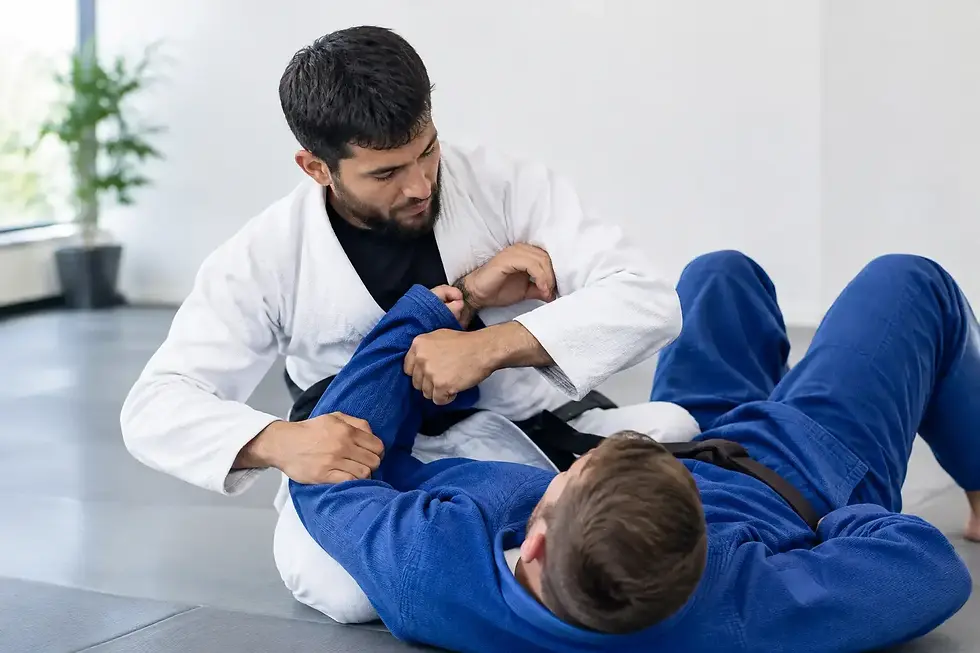
Keep your elbows connected when framing, especially under pressure from side control or half guard. Learn to post with a bent, active arm rather than a locked elbow whenever the situation allows. On takedown defense, avoid planting a twisting knee while your upper body rotates in the opposite direction. Those small choices protect the joints that take the most abuse over years of grappling.
This applies to grip fighting too. Death-gripping every collar, sleeve, or wrist may win a few exchanges, but it can leave your hands and elbows cooked before the real work begins. Use grips with intent. Release and re-grip rather than holding a losing position until your forearm is screaming.
Tap Earlier in Training Than in Competition
Training is where you collect skill, not damage. A clean submission caught late in a hard round is rarely worth testing your ligament tolerance. Tap early to fast rotational locks, stacked pressure, and heel hooks you cannot clearly defend. The most durable black belts are not fearless about injury. They are precise about risk.
Strengthen the Tissues Around the Problem Areas
BJJ joint health is not built only on the mat. Strength training gives muscles and tendons more capacity to control force before it reaches passive structures like ligaments and joint capsules. You do not need an endless accessory circuit. You need consistent work in ranges that grappling exposes.
For shoulders, prioritize pulling volume, controlled pressing, external rotation, and scapular control. Rows, pull-ups scaled to your elbows, carries, and moderate pressing can all earn their place. The goal is not to chase a pump after every class. The goal is to make your shoulders stable when someone is trying to flatten you, drag an arm across your centerline, or pull you into an awkward scramble.
For knees, develop strong quads, hamstrings, glutes, and calves. Split squats, step-downs, hamstring curls, sled work, and controlled hinging are useful because they develop strength through positions that resemble base-building, level changes, and wrestling exchanges. If deep knee flexion irritates a joint, reduce the range temporarily rather than forcing it. Pain-free training variations can maintain capacity while you address the underlying issue.
Elbows and wrists often need a more deliberate approach. Light wrist flexion and extension, pronation and supination work, finger extensor bands, and slow forearm loading can help balance the constant pulling and gripping of gi or no-gi training. Keep the load modest at first. Tendons often dislike sudden volume spikes, even when the resistance feels light.
Warm Up for the Round You Are About to Have
A few arm circles and a casual hip swing are better than nothing, but a useful warm-up prepares the positions your joints will actually face. Start by raising your temperature, then move through controlled ranges for the shoulders, hips, knees, wrists, and neck. Finish with a few technical movements at low intensity: sprawls, hip escapes, bridges, shots, grip exchanges, or stand-ups.
The warm-up is also a diagnostic. If your shoulder pinches during a simple controlled movement, that is information. Do not ignore it, then ask it to survive ten hard rounds. Modify the first part of class, tell your partner what is off-limits, and reassess as you get warm. Sometimes stiffness resolves. Sometimes it is your cue to change the plan.
Treat Recovery Like a Training Block
Sleep, food, hydration, and stress management determine how well your joints tolerate the work you demand from them. No recovery product can replace a consistent sleep schedule, adequate calories, protein-rich meals, and enough carbohydrates to support high-output sessions. Underfueling is common among athletes trying to make weight or stay lean, and it can make normal training feel unnecessarily punishing.
Build easy recovery into the week. A walk, light bike session, mobility work, or low-intensity drilling can improve circulation and help you stay moving without adding more mat damage. Complete rest also has a place, especially after a competition camp, a hard wrestling day, or a week where your readiness markers are trending down.
Bio-optimization tools can be part of a serious recovery strategy, but they should not become permission to ignore warning signs or multiply reckless training volume. If you are considering peptide-based products, make medical oversight, sourcing standards, and your competition rules part of the decision. Grapple Shield speaks to athletes who value recovery quality, but durable performance still starts with smart programming and disciplined habits.
Know the Difference Between Soreness and a Signal
Competitive grapplers are used to discomfort. That toughness matters, but it can also blur the line between normal training fatigue and a problem that needs attention. Watch for patterns, not isolated sensations.
Pain that gets sharper as a session continues instead of warming up
Swelling, locking, instability, numbness, or a sudden loss of range of motion
Pain that changes your mechanics, such as limping, avoiding a post, or protecting one arm
Symptoms that persist or worsen for more than a few days despite reducing load
Those signs justify a conversation with a qualified sports medicine professional or physical therapist. Early assessment can mean a few modified sessions instead of a forced multi-month layoff. It also gives you a specific plan rather than random mobility drills pulled from social media.
Make Your Training Partners Part of the System
The room matters. Choose partners who can train with pace and control, not people who treat every round like a tryout for a title shot. Communicate injuries before rolling, especially when a joint is irritated. A good partner can still give you a demanding round without attacking the exact position that is currently limiting you.
There is a trade-off here. Avoiding every uncomfortable position forever will leave holes in your game. The smarter move is graded exposure: rebuild strength, control, and confidence in a position before returning to full resistance. That is how you stay dangerous without gambling your season on one stubborn joint.
Your body is part of your competitive equipment. Maintain it with the same intent you bring to your passing sequences, escapes, and conditioning. The athlete who can train consistently has more chances to sharpen skill, build confidence, and be ready when the hard rounds count.


Comments